Trapping Marine Sediment
Readers of our previous blog posts may recall Rita, the academic intern who dedicated 2.5 months in early 2017 to a sediment trap project. It’s valuable work, but one that requires more time than a single internship allows, and she wasn’t able to complete it during her stay. This post picks up where she left off.
Some background on sedimentation is useful here. Marine sediment refers to any deposit of insoluble material, and sedimentation is the process by which these particles accumulate and settle on the seafloor (Gregory & Edzwald, 2010).
These particles form the seabed, which provides food and shelter for marine life such as algae, coral polyps, and plankton. Different species, however, thrive under different nutrient conditions: coral polyps prefer low nutrient levels, while algae favor high ones. When nutrient levels rise, algae can outcompete and outnumber corals. This can smother corals by blocking sunlight. Without light, the coral’s symbiotic algae, zooxanthellae, can no longer photosynthesize enough energy for their host, and the coral can eventually starve.
Beyond nutrients, the insoluble particles in marine sediment also include microplastics and other debris flushed into the ocean by rivers or inadequately treated sewage systems, and these can cause more damage than excess nutrients alone. Microplastics are fragments of plastic broken down to a size too small to see without a microscope, and they are readily consumed by fish and turtles, posing a serious toxicity risk to marine life. Once ingested, they can move up the food chain as smaller species are consumed by larger predators (Nelms et al., 2018), eventually reaching us as well.
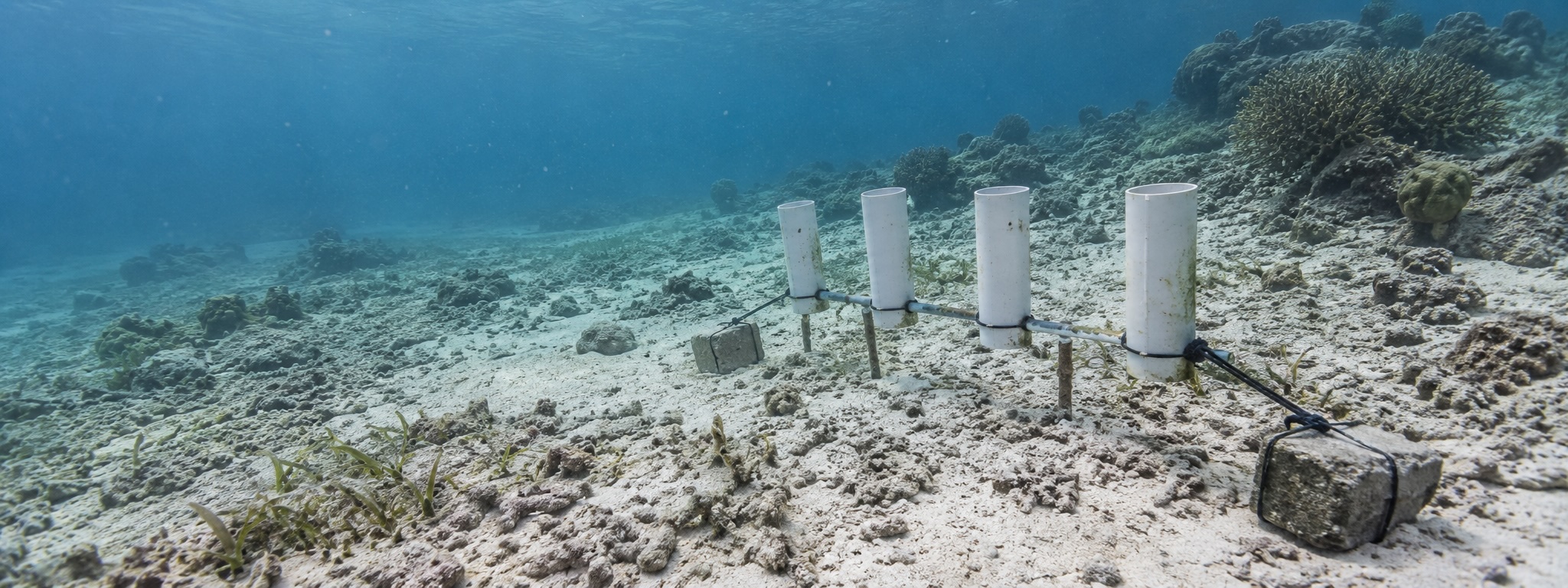
For these reasons, a well-designed sediment trap, used to collect and analyze sediment components, offers a direct way to assess nutrient levels and microplastic concentrations in shallow water. Building on Rita’s original project with some modifications, our current focus is identifying the best sediment trap design for the shallow water dive sites we use.
After reviewing the existing literature, we selected two methods for deploying the sediment traps: drifting moorings and anchored moorings. We are also testing different aspect ratios (length divided by diameter, which affects sediment collection efficiency) on the cylindrical traps attached to the rope. The design’s main advantage is its simplicity: only PVC tubing, rock, and rope are required, making it easy to replicate in rural areas or produce at low cost. If the traps can reliably collect sufficient samples for analysis, this simple design would allow more sites to be tested affordably.
Since the traps are made of PVC, we made a point of recovering failed units rather than leaving them in the water, retrieving as many as possible in mesh bags for reuse.
Within two weeks, however, all six traps had failed. The drifting mooring design did not hold, with traps carried away by the current, while the anchored mooring design stayed in place but suffered a different issue: the glued rubber bottom of the tube came loose. This points to a needed modification in how the trap’s base is constructed for future models.
Despite this initial setback, we are confident the overall design is sound. Next steps will follow a similar approach, testing cylindrical traps with different aspect ratios, but using only the anchored mooring position going forward. We will also improve the trap base by attaching sample bottles directly to the bottom of the traps with a stronger, underwater-rated adhesive, rather than relying on a glued rubber seal. This should make sample collection and trap reuse considerably easier, and we look forward to sharing the results of this next round of testing.
We will share further updates on our blog as this research develops.
Sources:
Gregory, R., & Edzwald, J. (2010). Sedimentation & Flotation. In R. Gregory, & J. Edzwald, WATER QUALITY AND TREATMENT. Colorado: AWWA & McGrawHill.
Nelms, S. E., Galloway, T. S., Godley, B. J., Jarvis, D. S., & Lindeque, P. K. (2018). Investigating microplastic trophic transfer in marine top predators. Environmental Pollution, 238, 999-1007.
Take part in our research
This kind of work rarely finishes with one person. This trap design continues where Rita’s project left off, and the next stage will likely be picked up by someone else in turn. If you’re interested in hands-on marine research like this, from designing field equipment to collecting and analyzing data, have a look at our current internship projects to see where you could get involved.

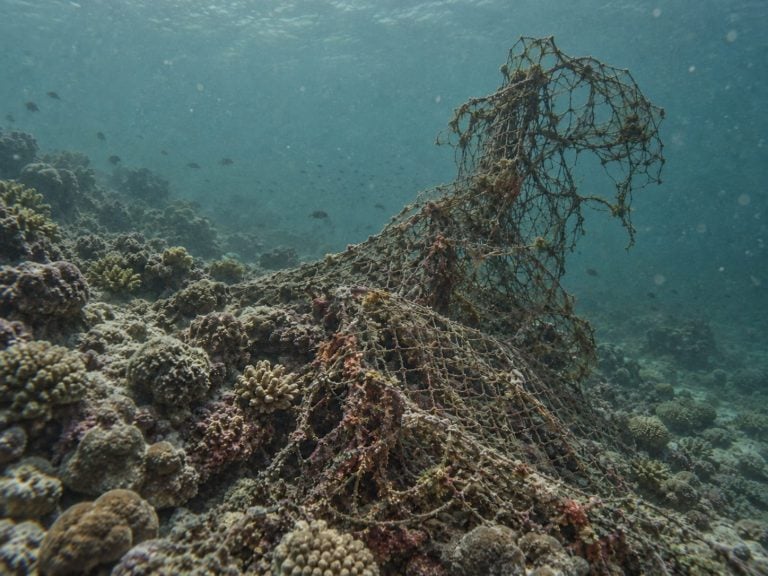

Before sediment traps,scientist assumed that nutrients and the tiny bodies of planktown would sink very slowly.Sediment traps are the only means for scientist to get hard data about the amounts and kinds of material that surface waters transport to the deep ocean.