Below the Surface: What 3,856 Surveys Reveal About Marine Trash
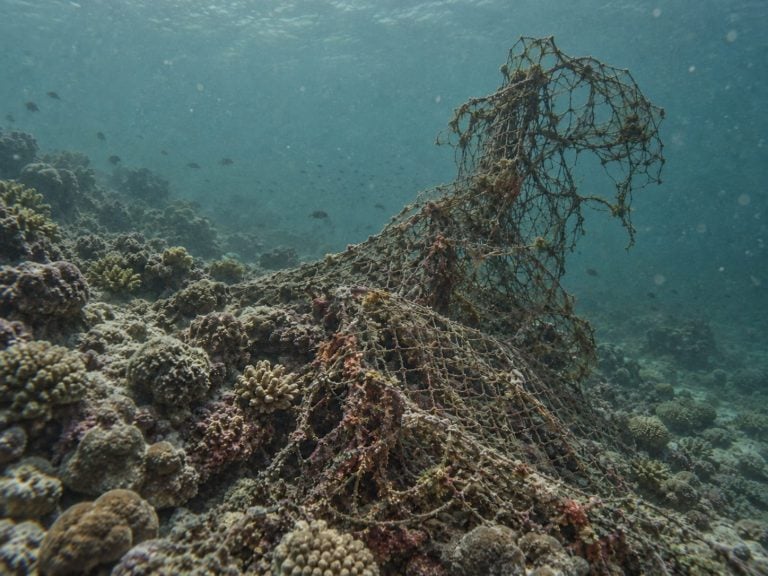
Walk along almost any coastline, and the impact of marine waste is obvious – but what happens once trash sinks beneath the surface? Down on the seafloor, discarded items don’t just sit passively on the sand. Everything from consumer packaging and glass to lost fishing gear becomes entangled directly into the reef architecture – smothering corals, blocking sunlight, and creating severe health risks for marine life. In fact, global studies show that corals coming into direct contact with submerged debris are up to 89% more likely to contract disease compared to those in clean waters.
Whilst floating litter grabs most of the public’s attention, understanding the true burden on our marine habitats requires a closer look beneath the waves.
To measure that impact locally, our latest report – authored by Research Intern Lars Peters from HAS Green Academy – takes a deep dive into our long-term dataset. Spanning eight years (2018–2026) and covering over 13,000 individual trash records across 12 monitoring sites in Zamboanguita and Siaton, this study marks the first comprehensive analysis of in-water reef debris in Southern Negros Oriental.
The study set out to answer three core questions: where is the trash coming from, where is it ending up, and why?
Two Distinct Pathways: Land vs. Sea
One of the biggest takeaways from the analysis is that not all reef trash arrives in the same way. Instead, the data points towards two separate pollution pathways, each driven by different factors and requiring different conservation solutions.
1. The ‘Source-to-Sink’ Route (Land-Based Trash)
Unsurprisingly, the single strongest factor determining how much domestic trash ends up on a coral reef is its proximity to river mouths and coastal markets.
- River Mouths and Markets: Sites closest to rivers (such as Guinsuan MPA and Dalakit MPA) or high-density hubs (such as the weekly Malatapay Market) consistently recorded the highest trash densities – standing in stark contrast to low-input sites like Andulay MPA and Antulang.
- Single-Use Packaging: A huge portion of this land-based debris consisted of soft plastic wrappers, shopping bags, food packaging, and single-use sachets. This pattern goes beyond individual littering; it reflects the widespread ‘sachet economy’ here in the Philippines, where lower-income households rely on small single-use packages due to daily budget constraints.
- Trapped in the Shallows: Once washed out by rivers or coastal runoff, these light consumer plastics tend to get snagged in shallow reef structures (such as in Dalakit MPA), creating concentrated hotspots close to shore.
2. The ‘Gravity and Current’ Route (Fishing-Related Gear)
Abandoned fishing lines, net fragments, ropes, and fish cages follow an entirely different rulebook.
- Sinking Deep: Unlike land-based items that get caught in the shallows, heavier fishing gear tends to sink and accumulate in the deeper part of reef zones. For many of our survey sites, this means medium (9–13m) and deep (15–19m) reef zones.
- The Flushing Effect: The study found that currents can play a key role in where gear settles. Stronger water movement can ‘flush’ loose debris off exposed reefs, whilst calm, sheltered conditions and complex topography allow ghost gear to snag and settle onto deep coral heads.
- Local Pressures: Sites like Latason MPA showed a profile dominated almost exclusively by abandoned nets and lines, driven by high local fishing pressure, including illegal fishing in and around the protected zone.

Short-Term Weather vs. Long-Term Drivers
Interestingly, the report found that short-term weather on the day of a survey – such as daily rainfall or wind speed – had almost no measurable effect on seafloor trash levels.
Why? Whilst daily weather or strong currents can temporarily boost the amount of drifting trash moving through the area, benthic debris tells a much longer story: it represents a gradual build-up over months and years. Heavy monsoon rains may flush waste into coastal waters, but once that trash sinks into the coral framework, it tends to stay there until it is physically removed or broken down.
However, seasonal monsoons do sometimes influence where trash accumulates. Dalakit MPA and Kookoos recorded higher trash loads during Amihan (the northeast monsoon), whereas Salag MPA and Latason MPA peaked during Habagat (southwest monsoon). Other sites, like Andulay MPA and Antulang, showed no seasonal shifts at all, maintaining a stable baseline year-round.
Long-term drivers are also evident in our multi-year data: trash density dropped to a low point in 2022 as monitoring resumed post-COVID-19, before climbing again through 2023–2024 as local human activity returned to pre-pandemic levels. This highlights how quickly reef pollution rebounds alongside human pressure, whilst simultaneously underscoring the importance of unbroken, long-term datasets to track these shifts!
What This Means for Conservation in Southern Negros
If land-based plastics and abandoned fishing gear travel along two different pathways, our cleanup and policy efforts must adapt accordingly. These findings shape our broader conservation recommendations and also directly inform MCP’s on-the-ground activities and long-term strategy:
-
- Targeted Resource Allocation:Rather than spreading cleanup dives evenly across every site year-round, efforts should be directed based on location and season. Cleanups should prioritise high-input areas near river mouths and markets, and be scheduled around seasonal peaks (such as targeting Kookoos during Amihan). Combining targeted cleanup dives with partner initiatives like ProOcean – who collect 400–600 kg of coastal trash every day – and LGU waste management improvements ensures we intercept debris before it spreads to adjacent reefs.
-
- Deep-Water Cleanups:MCP’s cleanup dives often focus on shallow-to-medium depths to maximise dive time, and in theory, clear higher volumes of trash. However, as lost fishing gear concentrates in deeper zones, dedicated retrieval dives could prioritise these depth ranges, particularly at high-risk sites.
-
- Working with Local Government Units (LGUs):Local Bantay Dagat (sea wardens) play a crucial role in enforcing fishing rules and managing MPAs, but marine patrols cannot stop land-based trash from entering the sea. We are sharing data from this report with local LGUs to help inform local waste management strategies and pinpoint where land-based interventions will have the biggest impact.
How You Can Help
- Be a Conscious Consumer: Western markets and local consumers alike drive the global demand for single-use plastics. You can make an impact from anywhere by choosing minimal-packaging alternatives, cutting single-use plastics, and advocating for Extended Producer Responsibility (EPR) initiatives that hold manufacturers accountable for their packaging waste long after it leaves the shelf.
- Report Lost Gear as a Citizen Scientist: If you are a diver, snorkeler, or local fisher, you can serve as an extra pair of eyes underwater. When you spot ghost nets or discarded fishing gear, report the location to conservation groups or local dive centres. Your real-time reports allow cleanup teams to remove hazards before they entangle marine life!
- Join Us as a Research Intern: If you are a student, graduate, or passionate conservationist looking to gain research-based field experience, apply to join us a volunteer diver or look into our Research Internship Programme. You can help collect the very data that helps shape local environmental policy.
- Spread the Word: Help us bring awareness to in-water reef pollution by sharing the findings with your network, university, or dive community!
A sincere thank you to Lars Peters for his hard work and meticulous analysis in bringing this eight-year dataset to life. We would also like to extend our gratitude to HAS Green Academy for their partnership and support in empowering the next generation of marine conservationists and researchers.
Want to dig into the statistical analyses, graphs, and individual site profiles? You can access the full report from our Articles and Publications page