Pipefish vs Seahorses: Differences, Ecology and Conservation in the Philippines
A familiar yet welcome sight when you go diving in the Philippines are the enigmatic pipefish. You may have noticed you encounter them much more frequently in the shallows, but how much do you actually know about them? We will tell you more about these beautiful creatures with their distinctive pre-historic appearance and fascinating life.
Memories of my childhood underwater adventures in a much more temperate climate than the Philippines still fill me with joy. Equipped with a snorkel and a mask I explored and discovered the weirdest creatures, crabs and crazy underwater forests of lush seaweed. Especially, I remember the sudden face-to-face encounter with my first pipefish. I had no idea what this creature was! Was it an eel, another kind of fish, or maybe something as scary (yet infinitely cool) as a baby snake?
Now, more than thirty years later, I still carry that same fascination for these intriguing animals. The pipefish is the closest relative of the seahorse, so closely related, in fact, that both belong to the same family: Syngnathidae. The name gives away their most obvious shared trait. “Syn” means joined and “gnathos” means jaw, referring to the fused, tube-like jaw that every species in the family carries. It’s the reason a pipefish’s long, narrow mouth looks so much like its more famous cousin’s.
Another trait every syngnathid shares is one of the animal kingdom’s more unusual approaches to parenting: male pregnancy. After a courtship dance that often carries the pair up toward the surface, the female deposits her eggs into a brood pouch on the male’s belly, where he carries and incubates them. Incubation runs longer than for most fish, so by the time a pipefish or seahorse gives birth, the offspring are already well developed.
Instead of scales, syngnathids wear armour-like, rigid bony rings for protection, tough, but not built for speed. The family is also remarkably diverse in size. The pygmy seahorses often found clinging to gorgonian fan corals on Philippine reefs are barely the size of a fingernail, while some pipefish species grow to more than half a metre long.
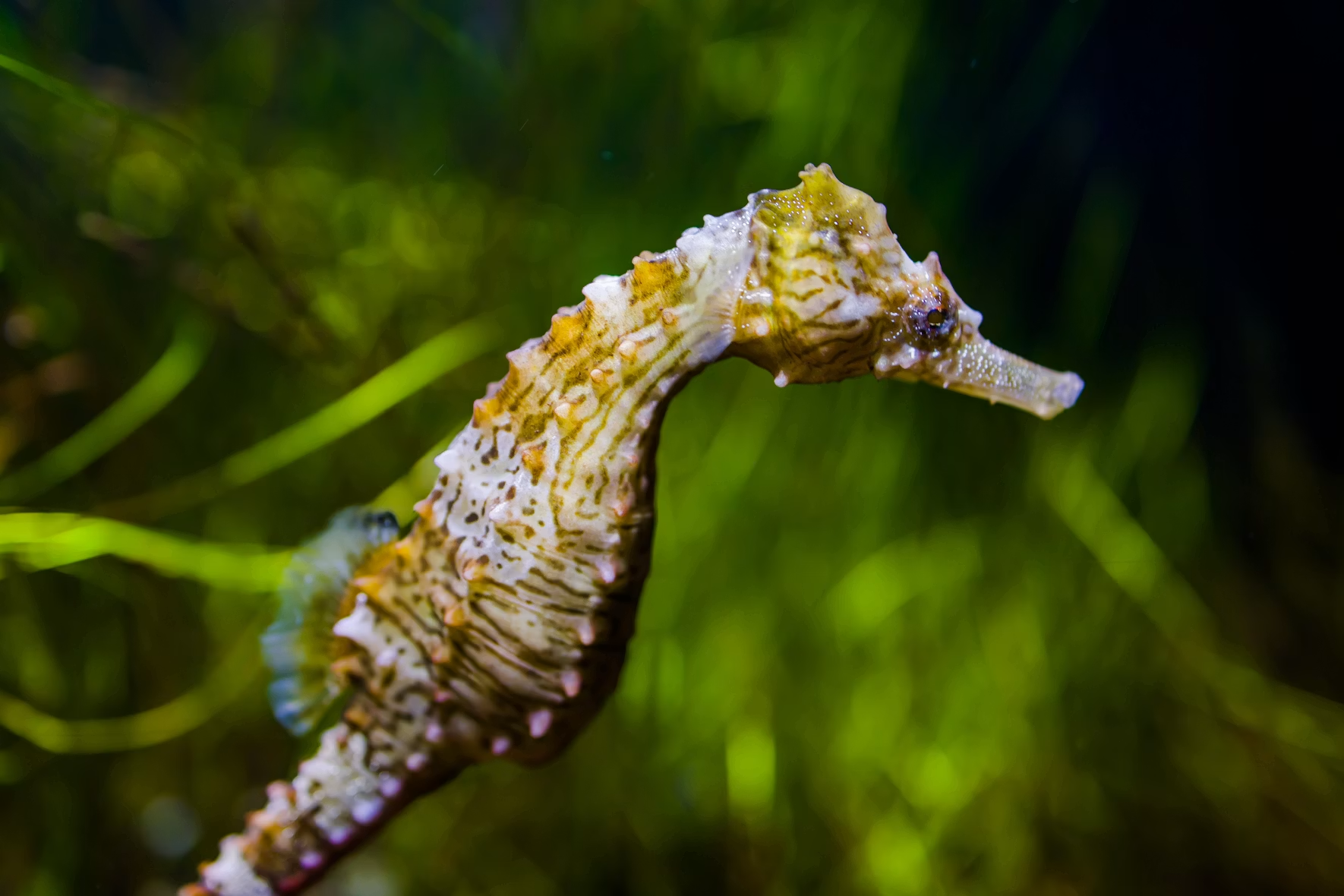
Despite their kinship, the two groups look and move quite differently. Seahorses get their name from their hunched, horse-like posture, and swim, and rest, upright in the water column. Pipefish, by contrast, have straighter, more elongated bodies and swim horizontally. Both have highly reduced fins that make them weak, slow swimmers, a limitation seahorses compensate for with a prehensile tail they hook around seagrass or coral to keep from being swept away by the current, while some pipefish rely instead on a small, rounded tail fin for propulsion.
This limited mobility comes at a cost: both groups have very small habitat ranges, sticking to the specific places where their camouflage works best. They can’t simply relocate if conditions change, which makes them especially vulnerable to habitat destruction, fishing pressure, and other disturbance.
That camouflage is where syngnathids really excel. Most species mimic their surroundings, seagrass, algae, sticks, feather stars, even the spines of certain sea urchins, closely enough that you can safely assume they’re there even when you can’t spot them. Hunting works on the same principle of stealth: pipefish are ambush predators, using their tube-like snout almost like a vacuum to suck in prey. As far as we know, all pipefish are carnivorous and diurnal, and despite their delicate appearance, they’re capable, patient hunters. Most stay close to the bottom, favouring the same lush seagrass meadows divers find them hiding in.
For all their camouflage, syngnathids remain prey for many benthic fish, lionfish among them, and once spotted, they have little defence. Their bony, sometimes thorny armour does nothing against a predator large enough to swallow them whole.
Trade demand adds another layer of pressure, particularly for seahorses. The Philippines has historically been among the world’s top suppliers of dried and live seahorses, driven by demand for traditional medicine and aquarium display. All seahorse species are listed under CITES (the Convention on International Trade in Endangered Species of Wild Fauna and Flora), an international agreement regulating trade in roughly 40,000 protected species, and the catch and trade of any CITES-listed species in the Philippines has been illegal since 2002. Before that regulation, the country’s recorded seahorse catch stood at around 4 million animals a year; by 2019 that figure had dropped to roughly 1.7 million, though the ban itself has made it harder for researchers to get accurate numbers, and the real total may be higher than what’s published.
Most recorded seahorse catch comes from compressor fishing, divers working off air hoses from a surface supply, which is itself a dangerous and illegal method. (It’s banned through a patchwork of local and provincial fishery ordinances, enacted under authority granted by the Philippine Fisheries Code: RA 8550, as amended by RA 10654) Beyond targeted fishing, the site fidelity and bottom-dwelling habits of seahorses and pipefish mean they’re frequently caught as bycatch in destructive gear like bottom trawling, which can wipe out entire local populations in a single pass.
Ultimately, though, the biggest long-term threat isn’t the trade, it’s what’s happening to the habitat itself. Coastal development and the everyday pressures of a growing population are steadily eating away at the seagrass beds and reef structures these fish depend on. Because syngnathids can’t simply move elsewhere when their patch degrades, habitat loss hits them harder than most.
That trade, though, provides real livelihood to many coastal communities, and the high prices seahorses command are part of why some fishers turn to increasingly risky methods to catch them. Protecting syngnathid populations can’t come at the cost of pushing fishing families further into precarious, dangerous work. The more promising path forward is likely one that does both: developing sustainable, regulated alternatives to current harvest practices, alongside genuine alternative livelihoods for the fisherfolk who now depend on this trade.
One quietly hopeful sign: divers report seeing more pipefish and seahorses on Philippine reefs than they used to. It’s perhaps worth being cautious about reading too much into that, divers are also getting better at spotting these masters of disguise, precisely because they’ve become such popular, charismatic subjects to look for. But it’s still a good reminder of why these weird and wonderful little fish are worth learning to see.
Reference: Foster et al., NFRDI Technical Paper Journal of Fisheries, Vol. 32


Hi, thanks for sharing. I’m wondering if it’s OK to copy some of the text in my site?