Visit by international boarding school
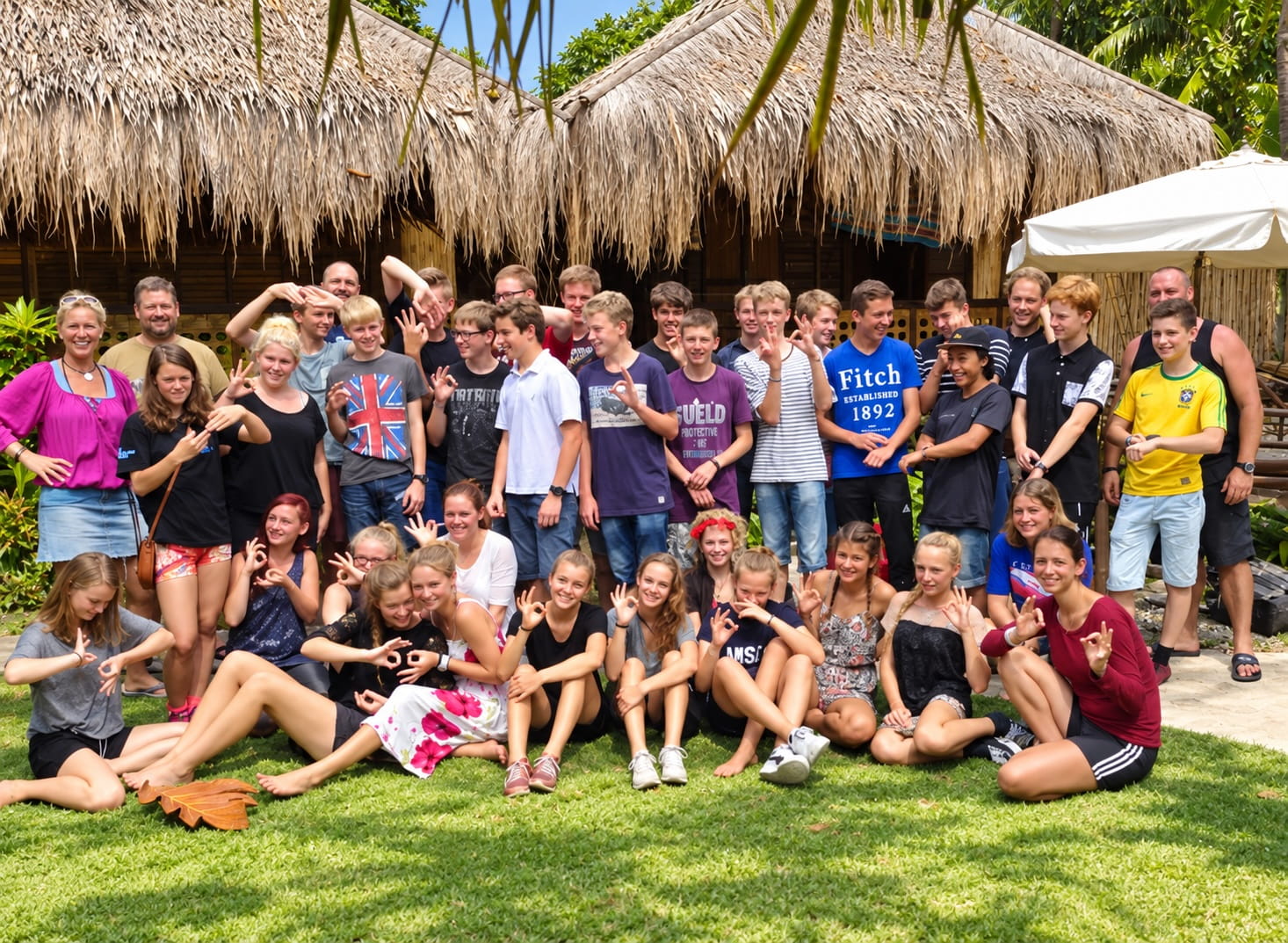
Just like last January, 22 students and three teachers from Ranum Efterskole College visited MCP in the middle of January for five days of diving and three days of cultural activities. Although even during the cultural part of the programme, one of our science officers managed to sneak the students off into the mangroves to teach them about these fascinating ecosystems!
It was a very rewarding, but also tiring, week for staff, volunteers, students and teachers alike, and at the end of it our visitors still had a very long flight back to Denmark ahead of them.
Preparing for marine research
The most interesting part of the dive programme for us was preparing the students to take part in our marine monitoring work. We wanted to find out whether it was possible to teach relatively inexperienced students everything they needed to know about surveying invertebrates in just two days, allowing them to spend their third day collecting data for our invertebrate surveys.
In theory, it seemed like a win-win situation: with such a large group, we could collect a considerable amount of useful data in a single day, while the students would go home having learned a great deal about marine biology, invertebrates and the practical realities of underwater research.
Surveying for invertebrates was an eye-opener for many of the students. Scuba divers, whether experienced or not, tend to focus on fish, and turtles of course, while overlooking entire groups of smaller animals, some of which hardly look like animals at all.
The students soon discovered that giant clams, cowries, nudibranchs, feather stars and many other invertebrates become fascinating once you start looking a little more closely.
Fortunately, everyone listened carefully during the briefings and avoided touching anything, at least intentionally! This was particularly important when encountering animals such as Diadema sea urchins, with their long, sharp spines, and cone snails, some species of which are venomous.
After a check-out dive, the students spent their next dives learning to recognise the different invertebrates and practising how to conduct a survey along a transect.
Research is harder than it looks
The actual data collection turned out to be quite challenging.
When surveying, you need to be close enough to the reef that you don’t overlook small invertebrates, while at the same time maintaining good buoyancy and making absolutely sure you don’t touch or damage the coral. While doing all that, you also have to remember to zig-zag along the transect line, stay within the defined survey area and correctly identify and count the animals you see.
It sounded relatively straightforward during the briefing. Underwater, it was another story.
Add a current pushing you along the transect, and collecting reliable data becomes considerably more difficult. It was a useful lesson for the students in just how much skill and concentration go into gathering scientific data underwater.
After the school group left, we asked our volunteers to repeat the surveys on the same transects so that we could compare their findings with those of the students.
The differences were substantial. On one set of 80 metres of transects, for example, the students recorded 35 feather stars, while our volunteers recorded 95 just four days later.
Although abundance can naturally vary and no single comparison tells the whole story, differences of this size made it clear that the student surveys weren’t reliable enough for us to use as scientific data.
In retrospect, we had expected too much. Our own volunteers receive much more extensive training before taking part in these surveys and, to be fair to the students, they are generally much more experienced scuba divers as well. Anyone interested in the techniques involved can find our current survey methodology and invertebrate survey materials on the MCP website.
That doesn’t mean the exercise was unsuccessful. Quite the opposite: it taught both the students and us something valuable about the difference between learning how marine research works and being sufficiently trained to collect scientifically robust data.
Our long-term surveys form part of MCP’s wider marine research programme, helping us monitor changes in reef ecosystems and better understand the effectiveness of marine protected areas.
A different approach next time
Afterwards, we evaluated the programme with our volunteers and discussed what we would change if the school visited us again.
Rather than focusing on collecting data for MCP’s scientific studies, we decided that the students’ understanding of marine life, research and conservation should be the main goal. We also wanted to include more dives with an immediate conservation purpose, such as reef clean-ups.
This would still give students first-hand experience of marine conservation while allowing our scientific surveys to remain in the hands of divers who have completed the necessary training.
That experience helped shape how we think about educational visits to MCP. Today, our school expeditions and marine conservation programmes are designed around exactly that principle: giving students meaningful, hands-on experience of marine biology and conservation while matching activities to their experience, abilities and learning objectives.
Education continues to be an important part of MCP’s work beyond visiting international groups too. Our youth education programmes work with young people in local communities to build understanding of marine ecosystems, environmental issues and conservation.
Turtles, Apo Island and student-led dives
Our final two diving days were spent at Apo Island, which proved very popular with the students. Everyone saw plenty of sea turtles, visibility was excellent, and during the final two dives the students had the opportunity to plan and lead their own dives.
Outside the water, the group also visited a local secondary school and the Malatapay cattle market, and spent a day exploring the Red Rock area, with its beautiful waterfalls and hot springs.
Together, these experiences gave the students a much broader introduction to the area than diving alone could provide.
There was, however, one part of the programme that our planning didn’t get quite right: thirst and snack cravings. When the school left, we discovered that we still had twelve crates of soft drinks and hundreds of candy bars! Our volunteers didn’t seem to mind too much…
On a serious side, the week gave us some useful lessons for future school programmes. Giving young divers the opportunity to experience marine research is enormously valuable, but experiencing science and producing reliable scientific data are not necessarily the same thing.
For future groups, we would put even more emphasis on curiosity, conservation and hands-on learning, and leave rigorous scientific data collection until there is enough time for the training it requires.
School excursions
Interested in bringing a school group to the Philippines for a hands-on marine conservation experience? MCP offers dedicated programmes for visiting schools, combining marine biology, conservation, diving and cultural experiences.
Find out more about school expeditions with Marine Conservation Philippines.