DIN or Yoke? What Every Diver Should Know About Regulator Valves
The Weakest Link in Your Dive Gear: DIN vs Yoke Regulators
Regardless of whether you use the DIN or yoke system on your scuba regulator, you’ll know that it’s in place to keep the first stage safely connected to the tank valve. It is the O-ring between the valve and the regulator that ensures the actual seal, and how you take care of it is more important than you may think. This connection is, in a sense, the weakest part of your dive equipment: if it fails, the tank will empty very rapidly. Exactly how fast it will empty depends on the size of the tank and the pressure inside it, but it is going to empty uncomfortably fast, quite possibly resulting in an out-of-air situation, if you’re doing normal single-tank recreational diving.
A failure could happen because of a worn O-ring, or if something impacts the valve, which can happen when striking the ceiling in a cave or a wreck. Therefore, a valve system that completely encircles and protects the O-ring is preferable. A yoke regulator, also known as an A-clamp regulator or an international regulator, is the most common regulator. The system is tried and tested and has been used for a long time. To attach a yoke-style first stage to a tank, a diver fits the metal brace over the tank valve and then tightens the yoke screw to clamp the first stage firmly in place. With this system, the O-ring is slightly exposed, and the brace and screw take up quite a lot of space. Though it’s a minor issue, it’s worth mentioning that this creates more drag in the water and, more importantly, is prone to entanglement.
A DIN (Deutsches Institut für Normung, though still commonly, if incorrectly, called “Deutsche Industrie Norm” – a holdover from the organization’s name before a 1975 rename) regulator first stage has a threaded post that screws into the inside of the tank valve. A DIN regulator’s first stage fits into one side of the tank valve, and no additional metal or braces run behind the tank valve. Therefore, the O-ring is protected, and the whole system is more streamlined and elegant.
There are two different kinds of DIN regulators and DIN valves: 200 and 300 bar. 300 bar valves are deeper and require a regulator with a longer post with more threads. (If you look at a DIN regulator count the threads on the stem. If it’s got seven it’s for 300 bar usage, but can be used on 200 bar tanks too. If it only has five, it’s only for 200 systems. This ensures a short stem will not reach the back of the orifice in a 300 bar tank and safely allow gas to whistle past, not destroying the regulator.) The difference lies in the amount of pressure the tank valve is rated to withstand. There is not much difference as far as the regulator is concerned, because the first few threads of the post do all the work. A 300 bar DIN regulator can be easily used on a 200 bar tank valve, but a 200 bar regulator will not seal properly to a 300 bar tank valve. Almost all regulators sold today can be fitted with a first stage for either DIN or yoke, and most are easily converted. If you own a yoke regulator, you’ll most likely be able to get it converted.
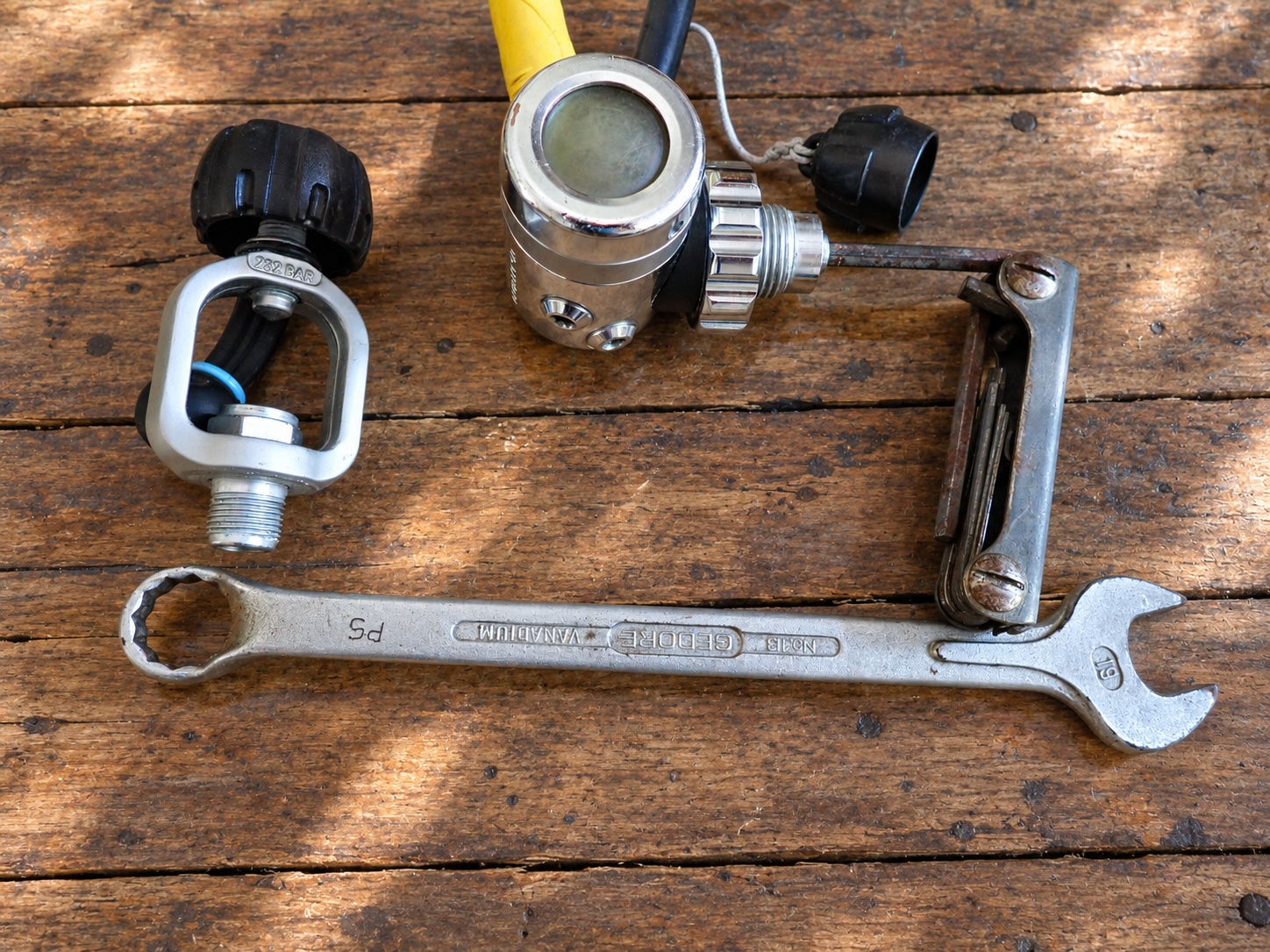
Many tank valves are easily converted as well. By screwing out the insert with a hex key, you make space for the DIN valve. When using the yoke system, the O-ring is located on the tank outlet (there’s actually a second one at the back of the valve insert as well, hidden away but still there nonetheless). When using the DIN system, the O-ring is placed in the regulator’s first stage. That’s another benefit of DIN regulators – if you own your own regulator, the O-ring belongs to you, so you can make sure it’s sound and lubricated. With the yoke system, you’re at the mercy of whichever dive shop you rent your tanks from.
The only valid argument against going DIN is the risk of compatibility issues when traveling abroad. This argument is becoming less true, as most recreational dive-tourism destinations now have tanks available that fit both valve systems. You could bring your own yoke adapter, just in case. This could be especially relevant if you’re traveling to American-dominated areas such as the Caribbean and certain places in Thailand. It may be a good idea to email your intended dive operator before packing your bags. If you are scuba diving in the Philippines, most regulators and tanks will be of the yoke system, but more and more tanks come with a removable insert so they can be converted on the fly. Your dive shop will no doubt have the hex keys you need to temporarily remove the insert.
At Marine Conservation Philippines, we use tanks with DIN valves and add inserts so they can also be used with yoke regulators. This means that if you’re a volunteer bringing your own scuba gear, whatever you bring will work fine.