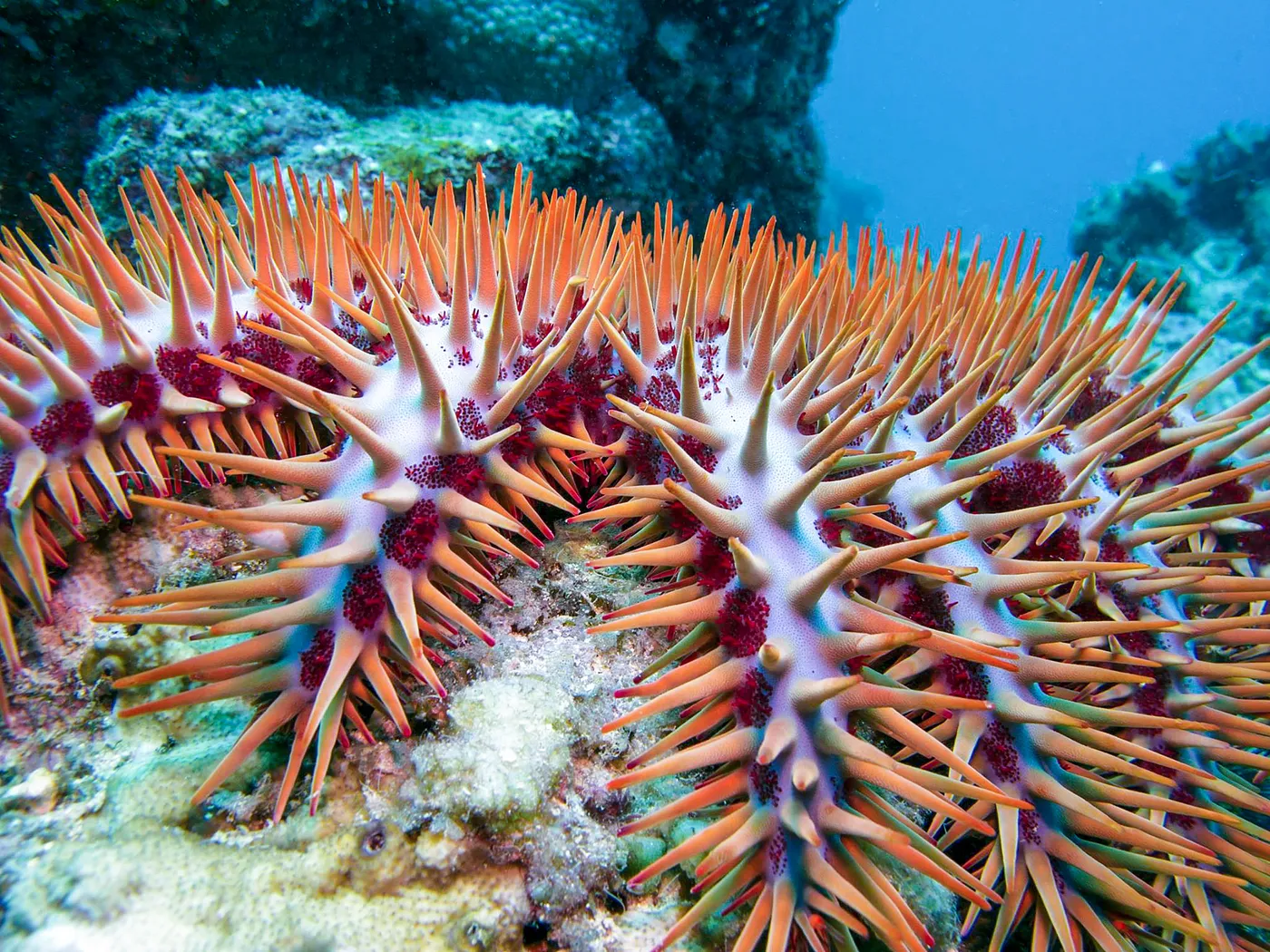
Crown of thorn starfish removal in Siquijor
Editor’s note — September 2026
This article describes fieldwork conducted in 2016 and should not be treated as a current operational protocol. Research published in December 2025 found that 70% of vinegar-treated male crown-of-thorns starfish spawned before dying, compared with 36.4% of males treated with bile salts. No treated females spawned during the study.
Because bile salts killed the starfish more quickly, the researchers recommend using bile salts where they are available, particularly during reproductive periods. COTS control should only be undertaken by appropriately trained and equipped teams, in coordination with the relevant local authorities and in accordance with current local guidance.
Further information
For guidance on planning and conducting a responsible response, download the Green Fins Crown-of-Thorns Sea Star Cleanup Guidelines.
The December 2025 research comparing spawning and mortality following vinegar and bile-salt injections is available through James Cook University ResearchOnline.
Together with a group of volunteers, we travelled to Siquijor to help respond to a crown-of-thorns starfish outbreak near San Juan. Over the course of four dives, we removed approximately 1,300 crown-of-thorns starfish.
Crown-of-thorns starfish, or COTS, as we will call them from now on, are native coral predators found throughout the Indo-Pacific. At low densities, they are a natural part of a healthy reef ecosystem. During an outbreak, however, their numbers can increase to the point where they consume living coral faster than the reef can recover.
The number of COTS seen during a dive varies considerably depending on the size of the area surveyed, coral cover, visibility and the experience of the divers searching for them. Nevertheless, finding hundreds during a single dive was an unmistakable sign that the affected reefs were under severe pressure.
Why do COTS outbreaks occur?
Scientists still do not fully understand why crown-of-thorns starfish outbreaks occur. Several interacting explanations have been proposed, including reduced predation, increased nutrient availability that may improve larval survival, and environmental conditions affecting reproduction and development. The relative importance of these factors may vary between reefs and regions.
One predator associated with COTS is the giant triton snail, although several fish and invertebrate species are also known to feed on COTS or their juvenile stages. The extent to which any individual predator regulates COTS populations remains uncertain.
A crown-of-thorns starfish resembles other sea stars but has many more arms and a body covered in long, sharp spines. These spines contain toxins and make the animals particularly hazardous to handle.
A puncture can cause severe pain, swelling and other symptoms, so contact should always be avoided. Despite our precautions, five volunteers were accidentally pricked during the operation. Fortunately, none experienced serious symptoms, but the incidents reinforced how carefully this work needed to be managed.
Choosing a control method
COTS control requires careful planning. Cutting or otherwise damaging the animals is neither reliable nor recommended because injured starfish may survive and regenerate lost tissue. Physical removal also creates risks for divers and may cause accidental damage to the reef.
At the time of this operation, two of the available approaches were manual collection and injection with a solution that would kill the starfish. Various substances had previously been used for injection, including bile salts, formalin and copper sulphate. Some were expensive, difficult to obtain or presented environmental and handling concerns.
Household vinegar offered a comparatively inexpensive and widely available alternative. The method in use at the time involved slowly injecting 20 ml of vinegar near the base of an arm. Earlier laboratory and field trials had found this to be an effective treatment, with mortality generally expected within 24 to 48 hours and no observed harmful effects on nearby corals, fish or other reef organisms.
More recent research (a decade later) has refined our understanding of this method, particularly during reproductive periods, as explained in the editor’s note above.
Improvising in the field
This was the first COTS response operation for most of our team, so we needed to adapt our approach to the conditions we encountered.
Ideally, injections would have been administered using a purpose-built applicator connected to a larger container. However, we had been called to Siquijor at short notice and did not have time to obtain the usual equipment.
Instead, each buddy pair entered the water carrying several syringes that had already been filled with vinegar, together with small bags of vinegar that could be used to refill them underwater. The assisting buddy carried the syringes, refill bags, a mesh collection bag, a stick and barbecue tongs in addition to the normal dive equipment. It was not the most elegant-looking arrangement, but it allowed the team to begin responding immediately.
The syringes worked reasonably well when the COTS were spread out across the reef. Once the available vinegar had been used, we carefully collected additional animals using tools and placed them in bags for transport to the surface.
Hundreds of COTS on a single dive
On our second day, we visited several particularly badly affected dive sites. Unfortunately, we had forgotten to bring the usual collection bags. Our dive crates proved to be a workable substitute, and by the end of the operation we had filled seven crates.
During one 40-minute dive, our teams collected approximately 500 COTS. It was an extraordinary number to encounter within such a short period.
The outbreak appeared to be concentrated near San Juan, and some dive sites were much more severely affected than others. This uneven distribution demonstrated why systematic surveys and continued monitoring were so important: clearing one section of reef did not mean that the wider outbreak had been brought under control.
After the dives, the collected COTS were taken ashore and buried in a sufficiently deep pit, ensuring that no hazardous spines remained exposed.
It was an intense three days of diving, teamwork and improvisation. We removed approximately 1,300 COTS, but at the time the outbreak was far from over. Effective COTS management requires continued monitoring, repeated visits and close cooperation between trained response teams, scientists, dive operators, communities and local authorities.


Good day!
I am a marine science graduate student studying in the Philippines, and I greatly appreciate your efforts in preserving Philippine coral reefs. I wish you all well in your future programs!
Sincerely,
EGDizon
May I ask the specific location of the outbreak in Siquijor. I am also a marine biologist who was employed in DENR Negros before but now im currently in DENR Cebu. I am curious as to the location of these outbreak so there would be possible monitoring for future outbreaks. Thank you