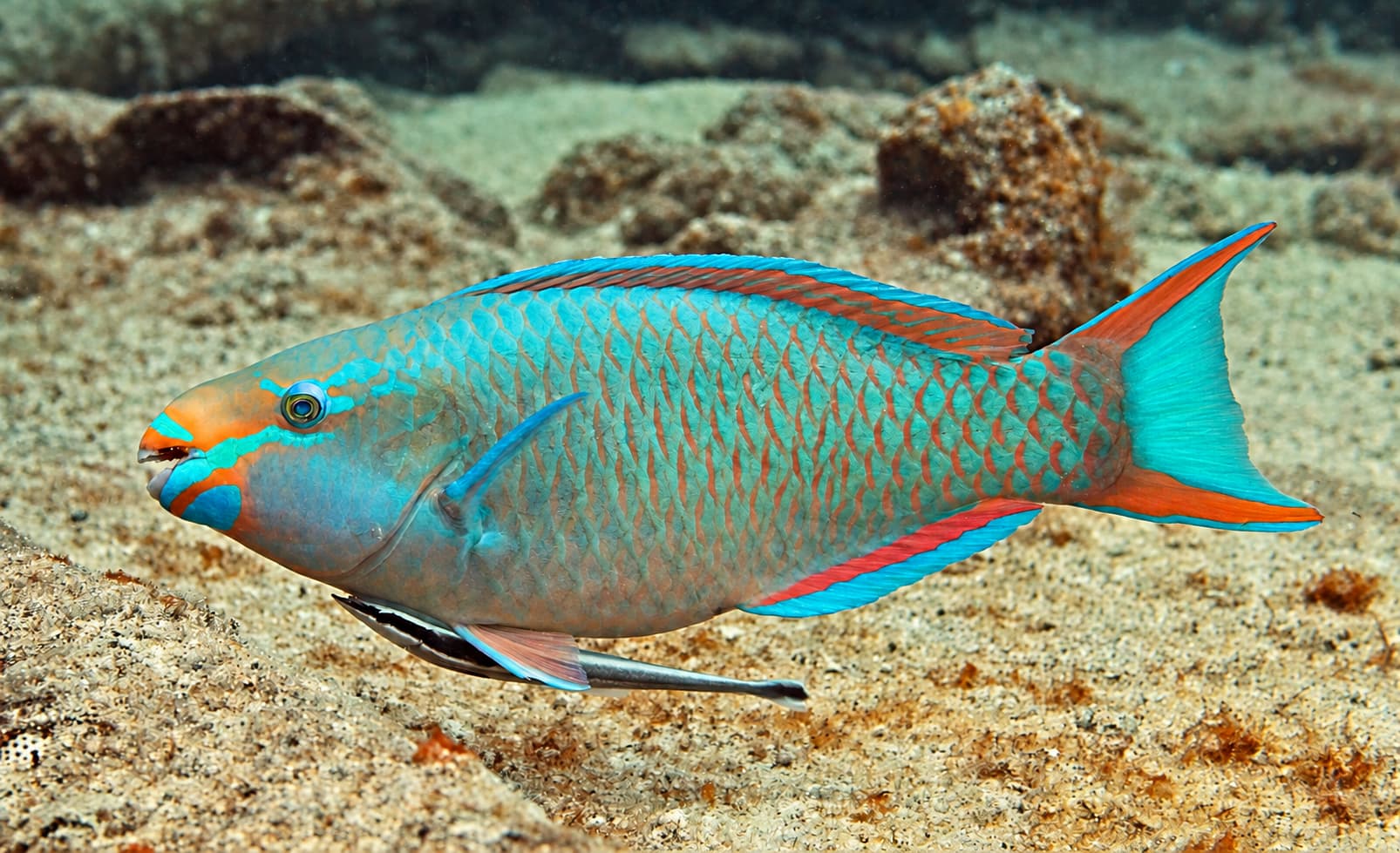
The importance of parrotfish poo
Humans usually settle on one gender and keep it for life. Fish are far more flexible. Some species are born male and become female, others the reverse, and some are born without a defined sex at all and develop one only when the group needs it. Take the anemonefish family living in your favourite anemone: it is not a family in the way it looks. The largest fish is the female, the next largest is her mate, and the rest are immature and sexless. If the female dies, her mate becomes female and the largest of the remaining fish takes his place. Parrotfish are a little less dramatic, but follow a similar logic: most start life as female and switch to male later on, when the reef needs more males. Sex change is not even the most interesting thing about them.
Parrotfish scrape algae off dead coral rubble and, at times, off live coral itself, which keeps algae from smothering the reef. That scraping picks up a lot of material they cannot digest: coral rock. What comes out the other end is fine sand. Spend a few minutes near a feeding parrotfish and you will see it, trailing a small cloud of sand as it grazes. That sand eventually washes up on shore, and the white sand on many tropical beaches is, quite literally, ground-up reef. A 2015 study in the journal Geology by Professor Chris Perry and colleagues at the University of Exeter found that parrotfish generate more than 85% of the new sand-grade sediment produced on the reef around Vakkaru Island in the Maldives, meaning the island itself is, to a striking degree, built from parrotfish waste. You can read the University of Exeter’s summary of the research here.
The biggest producer, by a wide margin, is the bumphead parrotfish (Bolbometopon muricatum). A single large bumphead can erode reef and excrete more than five tonnes of sand a year (Bellwood, Hoey and Choat, 2003), more than the weight of an adult African elephant, from one fish. That scale comes at a cost both ways. Bumpheads are heavily overfished, since they are large, easy to spot, and travel in schools. And because their jaws are powerful enough to bite into live coral as well as algae, large numbers feeding at once can visibly damage a reef. The BBC’s original Blue Planet series has some striking footage of exactly this behaviour.
MCP is interested in which fish species occur where across our dive sites, building on the baseline study we completed a few years ago. That groundwork feeds into our ongoing reef monitoring programme, where we watch for disturbances, natural or human-caused, over time. Right now we are working through which parrotfish species we actually have, alongside several other families. Identifying them is harder than it looks. Our volunteers will vouch for that: at first glance most parrotfish look alike, and it usually takes a close look, often from a photo, to tell them apart. Even after more than a dozen dives specifically looking for them, we are still finding species we had not logged before. We have not recorded a bumphead parrotfish at our sites yet, but with 21 other species logged so far, the variety here is already considerable.
We welcome all volunteers, but if you happen to be an ichthyologist specialising in parrotfish, now would be a particularly good time to visit.


