Ready for Reef Check surveys
Editor’s note — August 2026
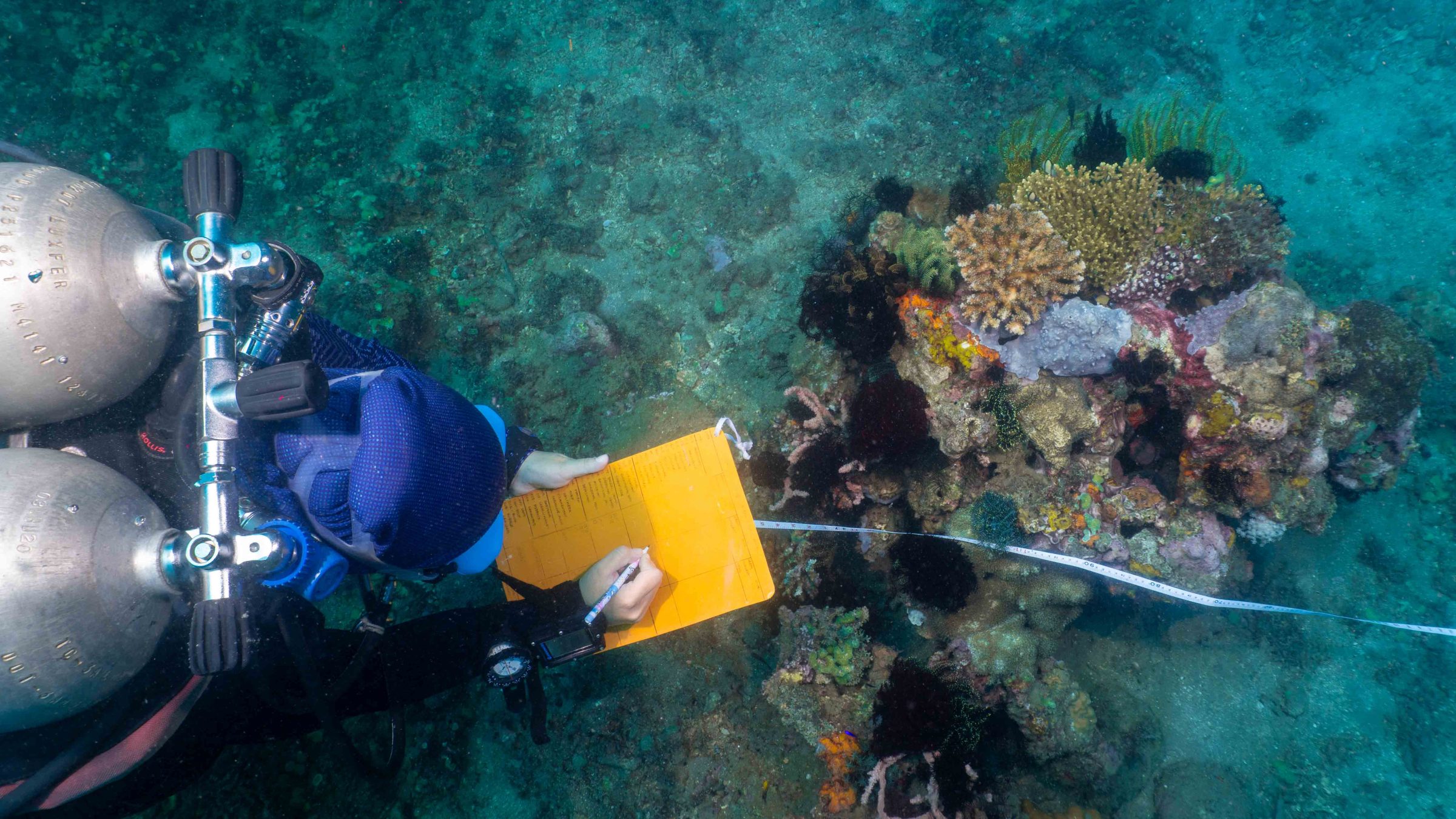
This post captured a very early moment for MCP: finishing our Reef Check EcoDiver training in February 2015, ahead of our first official reef survey alongside Silliman University and local dive operators. Reef Check is a globally standardized citizen-science protocol, built around a fixed transect design and a fixed indicator species list, so that volunteer divers anywhere in the world can collect comparable data—and it’s where we learned the fundamentals of reef monitoring.
Since then, MCP has developed its own ecological monitoring protocol, launched in 2017 and now running across multiple municipalities. It still shares some methodological DNA with Reef Check; we use the same core toolkit of belt transects for fish and invertebrates and point-intercept sampling for substrate. But we’ve diverged in several deliberate ways since: a third, deeper depth band to match our local reef profiles, a fish indicator list built from our own baseline research rather than Reef Check’s global list, finer-grained substrate and coral health scoring, and a dedicated predation survey outside Reef Check’s original three components.
The driving reason was food security. Reef Check’s methodology was reasonably adequate at describing broad reef health, but we found it insufficient for describing commercial fish biomass, and by extension, the food security question our monitoring program exists to answer. That’s what ultimately led us to build a protocol uniquely suited to the Philippines, and the critical issues of food security and enforcement of MPAs.
You can find documentation on our current monitoring protocol on our Marine Monitoring page.
A week ago, we organized a practice reef survey and a re-test for all the participants of December’s Reef Check course. To conduct a Reef Check survey, you need to be able to recognize a number of fish families and invertebrates, and tell the difference between substrates such as hard coral, soft coral, and nutrient indicator algae, among other things. That might sound easy, but some hard corals look just like soft corals, and not all algae are nutrient indicator algae.
We agreed with our tutor from the USA that MCP would be responsible for re-testing and for selecting the test photos of organisms found in this specific area. It was good practice for us too, since we had to select a lot of pictures for the fish and substrate tests.
The different snapper species still proved tricky during the practice session, but everybody now knows which species occur here and how to recognize them. It’s hard to tell from a photo whether a coral is hard or soft, since you can’t touch it. We ran a practice survey in the water, where each participating diver could focus on whichever topic they found most difficult, paired with someone more experienced in that area. Fortunately, everyone who took part passed, which means we are now fully ready for our first official Reef Check survey at the end of February, with 18 qualified EcoDivers. The Reef Check group consists of a team of students and a teacher from Silliman University, divemasters and dive instructors from local dive schools, other volunteers, and of course Marine Conservation Philippines. Together with this group, we are planning to survey the MPA Poblacion 1 dive site in Dauin twice a year, and to pick two other nearby reef sites for two further surveys.
At the moment, our science officers are exploring the different dive sites in Zamboanguita, which can be quite adventurous! So far we’ve made some interesting dives and seen a lot of patchy coral. The number of large fish, such as full-grown groupers or parrotfish, is small—an indication that a lot of fishing is going on. Many of the hard corals at some sites have been destroyed by typhoons, but they are definitely growing back. We’re also seeing a lot of soft coral and sponges. Conditions, coral cover, and the size and number of fish are all quite different compared to Dauin, which lies only 20km north: the variety of hard coral appears much higher, but there are fewer large fish and almost no continuous reef.
We are now in the windy season, which means some water entries can be a little challenging, with waves and surge. Many local dive sites have a very gradually sloping bottom and a rich population of echinoderms, so we have to take the tides into account and dive around high tide, when entry is easiest.
We are also planning to do a manta tow, which involves hanging onto a small board behind a boat while being pulled slowly through the water. This makes it easy to get a rough idea of the coral reef layout along a long stretch of coastline.