Spines, Stars, and Surveys: Managing a Crown-of-Thorns Outbreak
Armed with dive slates and syringes of vinegar, our survey and response teams have spent recent weeks monitoring and managing a Crown-of-Thorns outbreak at one of our longest-running Marine Protected Areas.
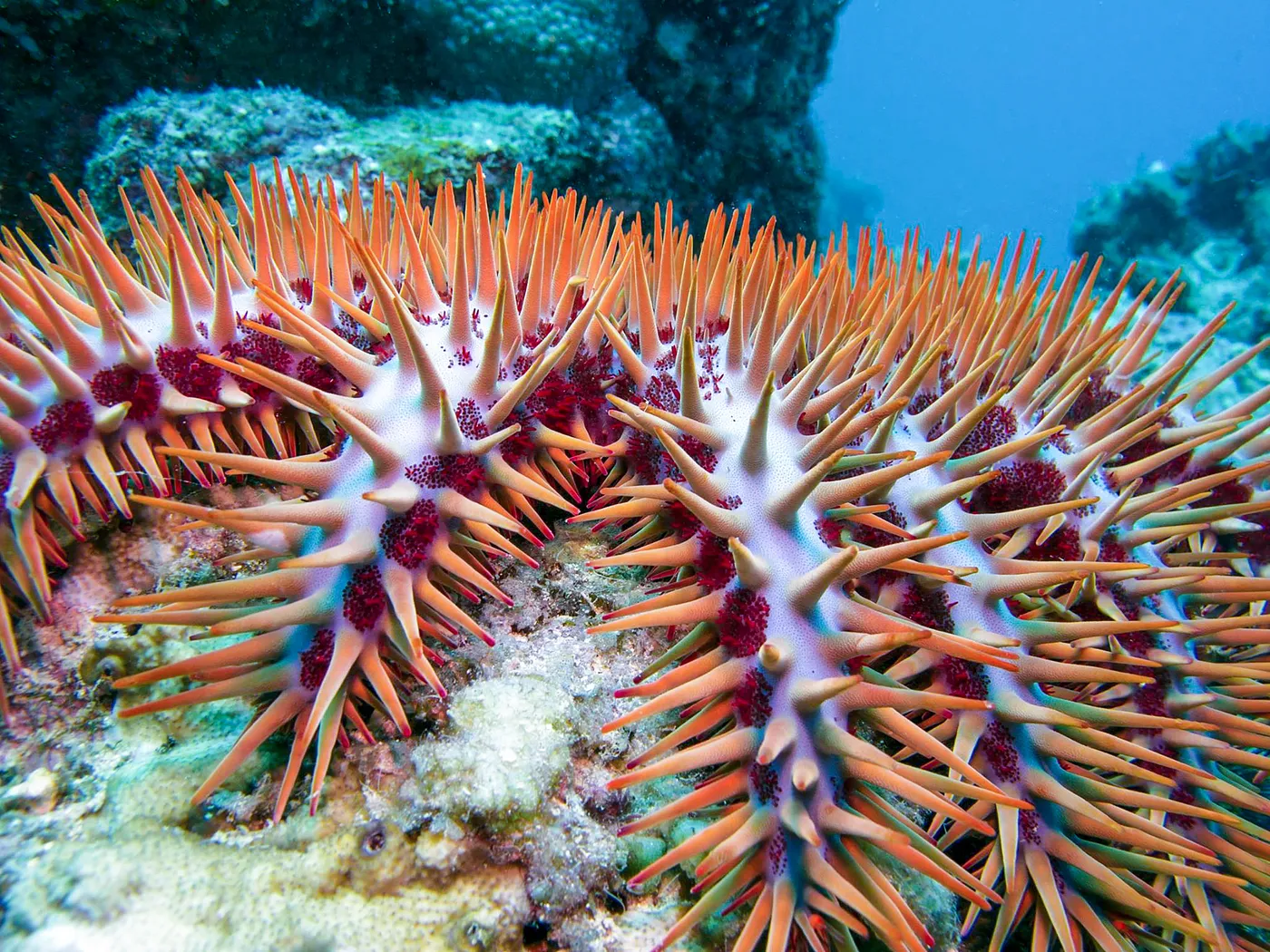
Crown-of-Thorns starfish (COTS) are native to reefs across the Philippines and the wider Indo-Pacific, where at natural densities they play a normal, even beneficial, role in reef ecosystems. They take their name from the sharp, venomous spines covering their upper body, and are highly effective corallivores, feeding almost exclusively on hard coral polyps. A single adult can consume up to 10 m² of reef-building coral per year, so when populations climb well above natural levels, the pressure on a reef escalates quickly.
Two further traits help explain how outbreaks can develop so fast. The same spines that make COTS such capable predators also limit their own natural predators to a small handful of species, most of which occur in relatively low numbers themselves. COTS are also prolific breeders: a mature female (30cm and above) can release anywhere from 60 to 200 million eggs in a single spawning season, with figures at the upper end of that range reserved for the largest, most mature individuals (Kettle and Adams, 1987).
The first signs came during a routine monitoring dive. COTS are typically nocturnal, staying hidden under ledges and in reef crevices during daylight hours, so when our survey teams began finding them out in the open in broad daylight at Andulay MPA, one of the oldest Marine Protected Areas in the region, it was an immediate red flag. It wasn’t the first time we’ve had to respond to COTS pressure at this site: we’ve previously carried out a removal at Andulay and a community day that doubled as a COTS response.

In response, a team of 12 staff and volunteers carried out a site-wide survey to assess the full extent of the outbreak. The field-recognised outbreak threshold is 15 individuals per hectare (Moran and De’ath, 1992), the density at which COTS consumption begins to outpace coral growth, and a figure since adopted by the Great Barrier Reef Marine Park Authority, Green Fins, and the Philippines’ DENR as the standard for field control decisions. Our first survey recorded a staggering 164 COTS within just 0.6 hectares, over eighteen times the accepted threshold, and it was immediately clear that intervention was needed.
Over the following weeks, and with permission from the DENR, our survey teams carried out multiple intervention dives to reduce the COTS population back to a healthy level. For this, each COTS was injected with 20 ml of household vinegar, an inexpensive and widely used method for responding to acute outbreaks.
As marine conservationists, we don’t take the decision to cull any marine organism lightly. We recognize the importance of every species in the ecosystem, and our goal is to preserve marine life. In this case, however, culling was necessary to safeguard the reef for the local community, an approach used effectively in COTS responses worldwide.
Our divers were careful not to inject every COTS they saw. These starfish are still a natural part of the reef, and by feeding on fast-growing corals, COTS help maintain balance, giving slower-growing species room to thrive. The aim was to restore the population to a healthy level, not to eliminate it.
So what causes COTS outbreaks in the first place? The likely answer is a combination of human-induced pressures. When there’s more farming or development along the coast, extra nutrients wash into the ocean, boosting the phytoplankton blooms that COTS larvae feed on and improving their odds of survival. Fewer predators, such as Triton’s Trumpet and Horned Helmet snails, due to overfishing, mean fewer COTS are removed naturally. And warming waters allow young COTS to grow faster and survive more easily. This outbreak was most likely driven by some combination of these factors, a reminder of how closely reef health is tied to pressures well beyond the reef itself.
This isn’t an isolated case either. COTS outbreaks have been recorded with increasing frequency across reefs in the Philippines and the wider Indo-Pacific in recent years, generally linked to this same combination of nutrient run-off, reduced predator numbers, and warming seas. Fortunately, we have the resources at MCP to continue monitoring and managing this outbreak for the foreseeable future. Through our long-term monitoring program, we’ll also be keeping an eye on neighbouring reefs and surveying any suspected outbreaks elsewhere, while our Science Officers collate the dive data and prepare a report for the relevant Local Government Units.
At MCP, our long-term monitoring program serves several purposes. In this case, it gave us the early warning that let us respond before the outbreak could spread further, one survey (and one starfish) at a time.
Editor’s note – September 2026
The vinegar-injection method described in this article should not be treated as a current operational protocol. Research published in December 2025 found that 70% of vinegar-treated male crown-of-thorns starfish spawned before dying, compared with 36.4% of males treated with bile salts. No treated females spawned during the study.
Because bile salts killed the starfish more quickly, the researchers recommend using bile salts where they are available, particularly during reproductive periods. COTS control should only be undertaken by appropriately trained and equipped teams, in coordination with the relevant local authorities and in accordance with current local guidance.
Further information
For guidance on planning and conducting a responsible response, download the Green Fins Crown-of-Thorns Sea Star Cleanup Guidelines.
The December 2025 research comparing spawning and mortality following vinegar and bile-salt injections is available through James Cook University ResearchOnline.